
栈的链表实现细节主要在Push()和Pop()例程中链表的实现不一样。
操作图示:
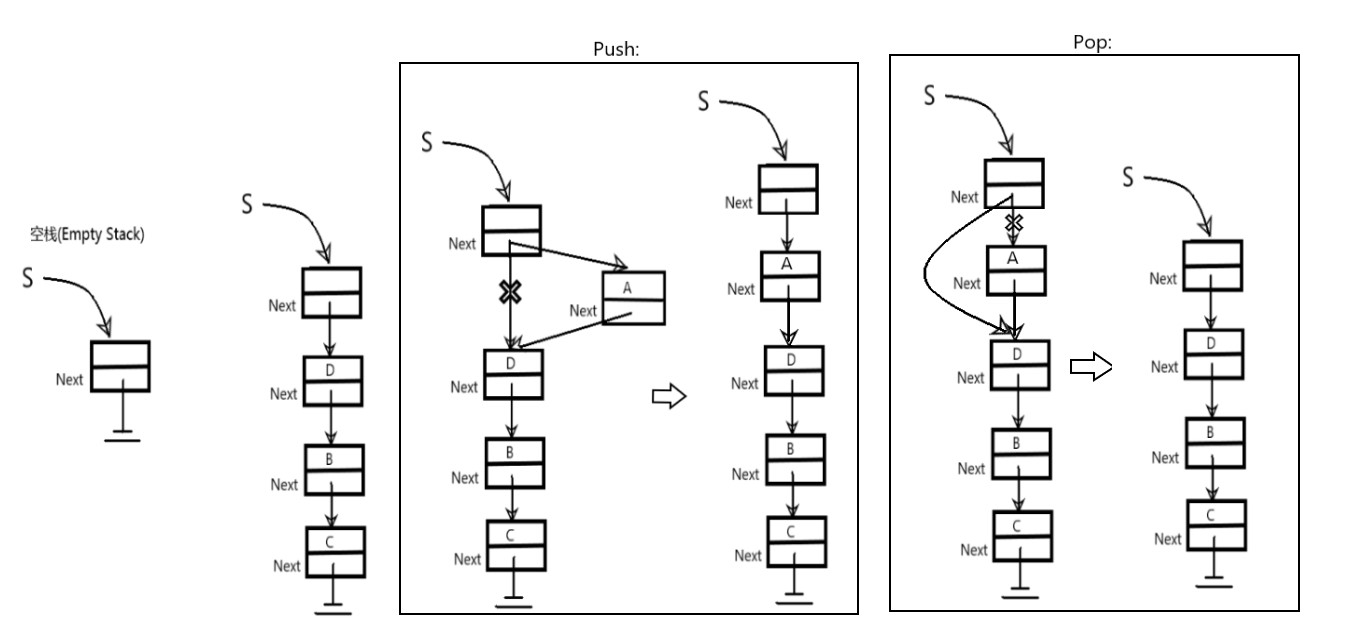
Stack.c:
#ifndef STACK_H
#define STACK_H

typedef char ElementType;
struct Node;
typedef struct Node *PtrToNode;
typedef PtrToNode Stack;

int IsEmpty(Stack S);
Stack CreatStack();
void MakeEmpty(Stack S);
void DiseposeStack(Stack S);
void Push(Stack S, ElementType X);
void Pop(Stack S);
ElementType Top(Stack S);
ElementType PopAndTop(Stack S);

#endif
LinkedStack.c:
#include"Stack.h"
#include<stdio.h>
#include<stdlib.h>

struct Node{
    ElementType Element;
    PtrToNode Next;
};

Stack CreatStack()
{
    Stack S;
    S = (Stack)malloc(sizeof(struct Node));
    if(S == NULL)
    {
        printf("sorry! malloc is failed!");
        return NULL;
    }
    else
    {
        S->Next = NULL;
        MakeEmpty(S);//confirm the stack is emptystack
    }
    return S;
}

int IsEmpty(Stack S)
{
    return S->Next == NULL;
}

void MakeEmpty(Stack S)
{
    if(S == NULL)
        printf("Please creatstack first!");
    while(!IsEmpty(S))
        Pop(S);
}

void DiseposeStack(Stack S)
{
    PtrToNode P, Tmp;
    P = S->Next;
    S->Next = NULL;
    while(P != NULL)
    {
        Tmp = P->Next;
        free(P);
        P = Tmp;
    }
}

void Push(Stack S, ElementType x)
{
    PtrToNode NewCell;

    NewCell = (Stack)malloc(sizeof(struct Node));
    if(NewCell == NULL)
        printf("Sorry! malloc is failed!");
    else
    {
        NewCell->Element = x;
        NewCell->Next = S->Next;
        S->Next = NewCell;
    }
}

void Pop(Stack S)
{
    PtrToNode FirstCell;

    if(IsEmpty(S))
        printf("Sorry the stack is empty!");
    else
    {
        FirstCell = S->Next;
        S->Next = FirstCell->Next;
        //S->Next = S->Next->Next;//这样最安全
        free(FirstCell);
    }
}

ElementType Top(Stack S)
{
    if(!IsEmpty(S))
        return S->Next->Element;
    printf("Sorry! the stack is empty");
    return 0;
}

ElementType PopAndTop(Stack S)
{
    PtrToNode FirstCell;
    ElementType FirstElement;

    if(IsEmpty(S))
        printf("Sorry the stack is empty!");
    else
    {
        FirstCell = S->Next;
        FirstElement = S->Next->Element;
        S->Next = S->Next->Next;
        free(FirstCell);
        return FirstElement;
    }
}